Vestibulodynia (formerly vulval vestibulitis)

In 1988 an American gynaecologist called Edward Freidrich described a group of women who experienced severe pain and discomfort of the vestibule area of the vagina. The vestibule is where the vulva (area of the skin on the outside) meets with the vagina. It is an extremely sensitive part of your body and contains the Bartholin¹s gland (which produces vaginal lubrication), the urethra (where you pass urine) and a number of the small minor vestibule glands which also produce vaginal discharge.

What are the symptoms?

The pain experienced by women with vestibulodynia is very individual. The main problem for women with this diagnosis relates to hyper-sensitivity on light touch to the vestibule, such as during intercourse and the insertion of tampons. The degree of pain is variable. Some women have pain but are able to tolerate penetrative sex. For others any pressure to the vestibule area causes symptoms of soreness and tenderness including tight clothes and even light touch to the area. Itching is not usually a feature of the condition.

Vestibulitis was the former term for vestibulodynia. This term is out of date now. It is slightly misleading as it implies that the vestibule is inflamed – hence the term vestibulitis. It is not believed that an inflammatory process in the skin is to blame for symptoms. An excessive sensitivity of the nerve fibres and even, on occasions, overgrowth of the nerve fibres in the area is believed to be responsible for symptoms.

Although the pain on light touch is the main symptom it is wrong to think that this is a skin condition. When sex has been painful for some time there are inevitable effects on your sex-life. Tension in the lower pelvic floor muscles during attempted sex can lead to increased pain and subsequent avoidance. If communication breaks down between a couple then this can lead to further disharmony. In some couples where the symptoms have been present for many months/years, provoked vulvodynia can alter sexual function and a referral to a psychosexual counsellor is necessary. For further information contact VPS.

What is there to see on examination?

Vestibulodynia is a very real physical disease. Often on examination of the vestibule there is tenderness to light touch. There can be red areas at the site of tenderness, but frequently the findings are normal. Just because your doctor cannot see anything does not mean that there is nothing present.

What tests should be done?

Vestibulodynia should be diagnosed by a doctor who should rule out infections and vulval skin conditions which may cause similar symptoms. Many doctors, however, are unaware that the condition exists and often regard the condition as 'thrush'. Your doctor should listen to your symptoms, examine the vulval area and refer you to a specialist necessary. This specialist would be either a gynaecologist, dermatologist or a genito-urinary (GUM) physician. If thrush is s uspected by your doctor then it should be confirmed by performing a vaginal swab. Repeated vaginal anti-thrush treatments make the condition worse so insist on oral treatment instead, with Diflucan or Sporanox, for instance.

How is it treated?

As there is no obvious cause for symptoms, it is difficult for many women (and some doctors) to understand the condition. There are many conditions that it is not! It is not infective, it is not related to cancer, it will not spread to other parts of your body and you will not pass it on to your partner.

The treatments available for this condition are very variable. Different doctors treat the condition in different ways but below are a selection of suggested treatments. Not all doctors will use these methods, but you can discuss the different options with him/her. Some treatments will help some women and not others. Treatments range from local anaesthetic cream/gels, vaginal dilators, pelvic floor muscle physiotherapy, psychosexual counselling and rarely surgery.

You can read more about the surgical option here, but please remember always to ask for a second opinion. Surgery is very much an option of last resort and you should explore every other option first.

Be careful of non-prescribed creams on the vulva as some can cause vulval irritation. Remember the strict vulval hygiene measures that you should practice (see the self-help page).

What causes it?

It is likely that a number of factors cause vestibulodynia, but often no identifiable cause can be found. Some women have a sudden onset of symptoms following a specific event and this is commonly recognised a severe attack of thrush followed by anti-thrush treatment. Once the attack of thrush settles following treatment, soreness and burning may persist as vestibulodynia. Some women complain of vestibulodynia following childbirth, or the use of certain bubble-baths and soaps or with the use of antiseptic in the bath eg Dettol. Where symptoms have gradually occurred over some time, even years, then it¹s difficult to identify a cause. Some women with interstitial cystitis also suffer from the condition. The reasons why the two conditions are connected remain unknown.

Treatments available from your doctor

Local anaesthetic gel is a waterbased gel which contains a weak amount of a local anaesthetic such as Lignocaine. The anaesthetic can 'numb' the nerves in the skin temporarily and may be used safely on a regular basis. Many women have gained considerable benefit using the treatment particularly with vestibulodynia when used half-an-hour prior to sexual intercourse. They find it helpful to rub the gel into the tender areas – this helps numb the skin and also can help overcome tension in the pelvic floor muscles. The gel can now be bought over the counter. Make sure that you use a test dose first on a small area of the vulva as around 10 per cent of women can have a skin reaction to it.

Vaginal dilators can be inserted to relax the muscles around the entrance to the vagina and to gently stretch the area. These can be helpful to overcome the tension in the pelvic floor muscles that can occur in vestibulodynia.

Tricyclic antidepressant tablets may be useful if the pain that you have is more constant in nature. This is used in low dosages to treat pain directly at the nerves endings in the skin.

Read more about surgery, pelvic floor exercises and other treatments.

Summary

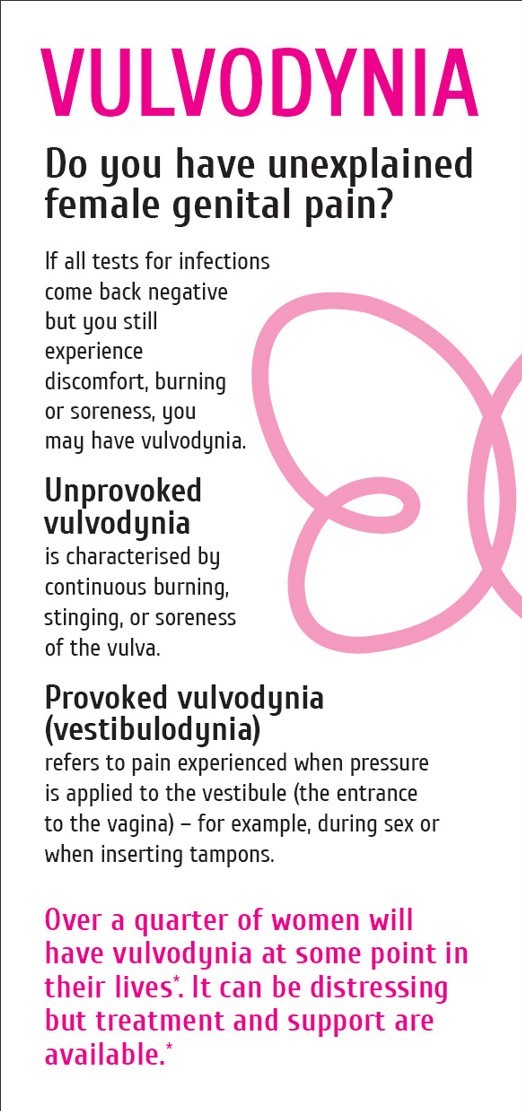
    Vulvodynia (unprovoked pain)
  • Spontaneous pain
  • Pain is burning and sore in nature
  • Itching not usually a problem
  • Can be generalised around the vulva or localised
    Vestibulodynia (provoked pain)
  • Pain with light touch eg tampon use or sexual intercourse
  • Usually no symptoms at other times
  • Can be generalised around the vulva or localised

See the self-help page for more information.